
Artificial intelligence has fundamentally changed how people discover information online.
Instead of searching only on Google, users now ask questions directly in ChatGPT, Google’s AI Mode, Perplexity, Claude, Gemini, and other AI assistants. These systems generate answers by combining information from multiple trusted sources rather than simply listing webpages.
This shift means traditional SEO is no longer enough.
To stay competitive in 2026, businesses need an optimization strategy that works for both search engines and AI-powered answer engines.
In this guide, you’ll learn:
- What AI SEO is
- What Generative Engine Optimization (GEO) means
- How AI search differs from traditional Google Search
- Practical optimization techniques
- Technical SEO requirements
- Content strategies
- Entity SEO
- Common mistakes to avoid
- Future trends
Whether you run an eCommerce store, SaaS company, local business, or enterprise website, these strategies will help increase your visibility across both traditional and AI-powered search.
What Is AI SEO?
AI SEO is the practice of optimizing websites and digital content so that artificial intelligence systems can understand, trust, retrieve, and reference them when generating answers.
Traditional SEO focuses primarily on ranking webpages.
AI SEO focuses on becoming a trusted source of information.
Instead of asking:
“How do I rank #1?”
The better question is:
“How can my website become the source AI systems trust?”
What Is Generative Engine Optimization (GEO)?
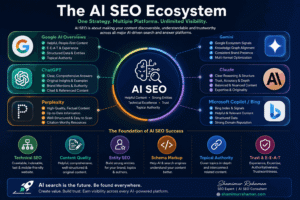
Generative Engine Optimization (GEO) extends SEO beyond search engines.
Its goal is to increase the likelihood that AI assistants reference your content when answering users’ questions.
These include:
- ChatGPT
- Google AI-powered search experiences
- Gemini
- Claude
- Perplexity
- Microsoft Copilot
GEO combines:
- Technical SEO
- Structured content
- Entity optimization
- Knowledge graph signals
- Topical authority
- Trust and credibility
- Helpful, original content
Traditional SEO vs AI SEO
| Traditional SEO | AI SEO |
|---|---|
| Optimize for rankings | Optimize for answers |
| Focus on keywords | Focus on topics and entities |
| SERP clicks | AI citations and mentions |
| Individual pages | Knowledge ecosystem |
| Backlinks | Authority + accuracy + relationships |
| Search intent | Conversational intent |
The two approaches complement each other rather than replace one another.
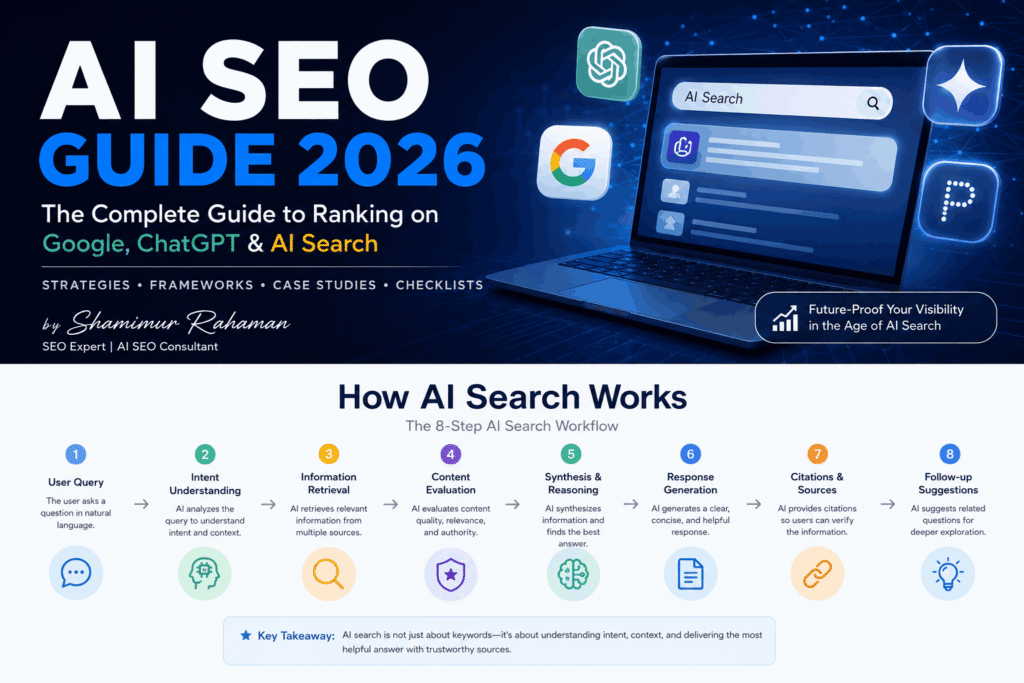
How AI Search Works
Although different AI systems use different methods, they generally follow a similar process:
- Understand the user’s question.
- Identify the intent.
- Retrieve relevant information.
- Evaluate authority and relevance.
- Generate a natural-language answer.
- Reference or recommend reliable sources where appropriate.
This means your website must be:
- Easy to understand
- Well structured
- Technically sound
- Factually accurate
- Consistently updated
The Core Pillars of AI SEO
1. Technical SEO
Without a technically healthy website, AI systems and search engines may struggle to access or interpret your content.
Key areas include:
- Fast page speed
- Mobile-first design
- HTTPS
- XML sitemap
- Robots.txt
- Canonical URLs
- Clean URL structure
- Crawl efficiency
- Structured navigation
2. Entity SEO
Modern search is increasingly entity-based.
Instead of optimizing only for keywords, build clear relationships between:
- People
- Companies
- Products
- Services
- Locations
- Topics
- Organizations
Example:
Instead of creating isolated articles about SEO, create an interconnected content ecosystem covering:
- Technical SEO
- Local SEO
- Ecommerce SEO
- Link Building
- AI SEO
- GEO
- Content Strategy
Each page should reinforce the others.
3. Topical Authority
Publishing dozens of unrelated articles is less effective than becoming an authority in one domain.
Create topic clusters.
Example:
Main Topic
AI SEO
Supporting Topics
- GEO
- AI Search
- Structured Data
- Schema
- Entity SEO
- Prompt Search
- AI Crawlers
- Search Intent
- AI Content Optimization
This demonstrates depth and expertise.
4. Structured Content
AI systems prefer content that is easy to parse.
Use:
- Clear headings
- Bullet lists
- Tables
- Step-by-step explanations
- FAQs
- Definitions
- Summaries
Avoid long walls of text.
5. Original Expertise
AI systems increasingly favor information that reflects genuine expertise.
Strengthen your content by including:
- Case studies
- Original research
- Practical examples
- Screenshots
- First-hand experience
- Unique insights
- Real-world data
Content Optimization for AI
Every article should answer:
- What is it?
- Why does it matter?
- How does it work?
- When should it be used?
- Who benefits?
- What are the limitations?
This structure aligns well with both human readers and AI systems.
Schema Markup Matters
Implement structured data where appropriate, such as:
- Organization
- WebSite
- Article
- FAQ
- Breadcrumb
- Person
- Product
- Service
- Local Business
Schema helps search engines interpret relationships between your content.
Internal Linking Strategy
Every important page should connect naturally with related content.
For example:
AI SEO
↓
Technical SEO
↓
Schema
↓
Content Marketing
↓
Link Building
↓
SEO Audit
↓
Keyword Research
Strong internal linking improves discoverability and topical relevance.
Build a Knowledge Graph
Treat your website as a connected knowledge base rather than a collection of isolated pages.
Map relationships between:
- Services
- Industries
- Authors
- Locations
- Categories
- Clients
- Projects
- Resources
This supports both search engines and AI understanding.
Optimize for Conversational Search
Users increasingly search with natural language.
Instead of targeting only:
AI SEO
Also answer questions such as:
- What is AI SEO?
- How does AI SEO work?
- Is GEO different from SEO?
- How do I rank in ChatGPT?
- How can my business appear in AI search results?
Use these questions naturally within your content.
Common AI SEO Mistakes
Avoid these pitfalls:
- Publishing thin content
- Creating duplicate pages
- Ignoring technical SEO
- Overusing keywords
- Producing AI-generated content without review
- Weak internal linking
- Missing structured data
- Outdated information
- Publishing without demonstrating expertise
Measuring Success
Track metrics beyond rankings, including:
- Organic traffic
- Qualified leads
- Topic visibility
- Indexed pages
- Click-through rate
- Brand searches
- User engagement
- AI referral traffic (where measurable)
- Mentions or citations in AI experiences
A combination of analytics platforms and webmaster tools can help monitor these indicators.
The Future of SEO
SEO is not disappearing.
It is evolving.
The businesses that succeed will combine:
- Technical SEO
- Content quality
- Entity optimization
- User experience
- AI-friendly structure
- Brand authority
- Continuous publishing
The goal is no longer just to rank pages—it is to become a trusted source of information that both people and AI systems rely on.
Final Thoughts
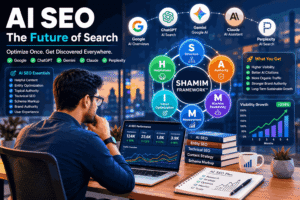
AI-powered search is reshaping how information is discovered, but the fundamentals remain familiar: publish accurate, useful, well-structured content and maintain a technically strong website.
Businesses that invest in AI SEO and Generative Engine Optimization today will be better positioned to earn visibility across Google Search, AI-powered search experiences, and conversational assistants in the years ahead.
Rather than optimizing for a single algorithm, focus on creating trustworthy, comprehensive resources that genuinely help users solve problems. That approach is likely to remain valuable regardless of how search technology evolves.
Frequently Asked Questions
What is AI SEO?
AI SEO is the process of optimizing your website so AI-powered search systems and traditional search engines can better understand, retrieve, and surface your content.
Is AI SEO different from traditional SEO?
Yes. Traditional SEO emphasizes ranking webpages, while AI SEO also focuses on becoming a trusted source for AI-generated answers. Both strategies work best together.
What is Generative Engine Optimization (GEO)?
GEO is the practice of optimizing content for AI-powered answer engines by emphasizing clarity, authority, structured information, and topical depth.
Can AI-generated content rank?
Yes, but quality matters. Content should be accurate, original, fact-checked, and provide real value. Publishing unreviewed or low-quality AI-generated content is unlikely to perform well over time.
Is technical SEO still important?
Absolutely. Site speed, crawlability, structured data, mobile usability, and clean architecture remain foundational for both search engines and AI systems.
About the Author
Shamimur Rahaman is an SEO Consultant specializing in Technical SEO, AI SEO, Generative Engine Optimization (GEO), Entity SEO, and scalable organic growth strategies for businesses worldwide.
