
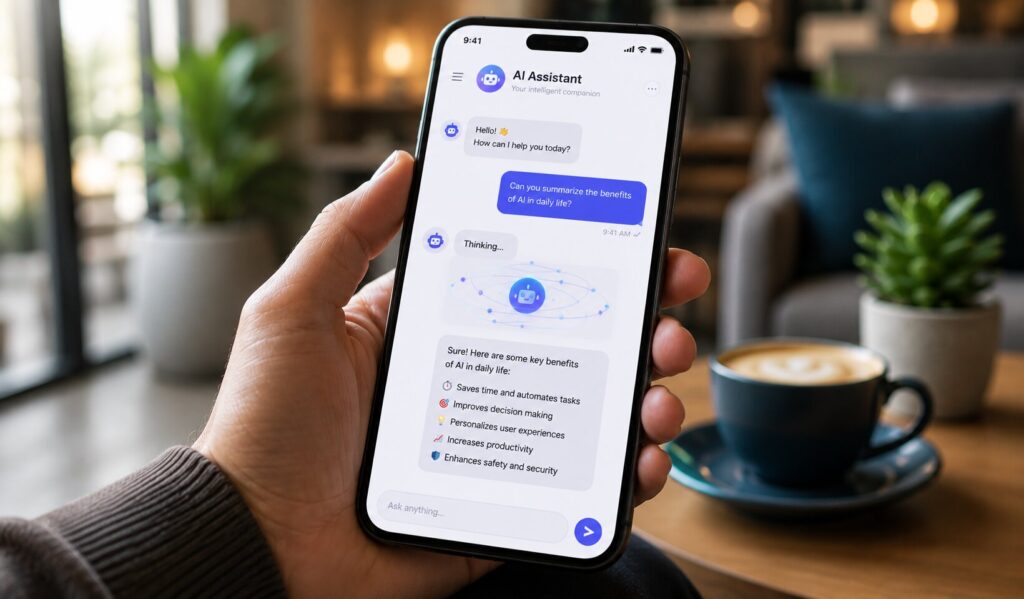
A growing share of searches never touch Google at all anymore. Customers are asking ChatGPT, Perplexity, and similar AI tools directly — “recommend a good SEO consultant in Dhaka,” “what’s the best local restaurant near Gulshan” — and getting a direct answer, often with a specific business named, without ever opening a traditional search engine.
As an SEO Consultant watching this shift closely, I want to walk through what’s actually changing, how big this shift is in Bangladesh specifically, and what your business needs to do to stay visible in these new AI-driven conversations.
How AI Chatbot Search Differs From Traditional Search
Traditional search shows a ranked list of links and lets the user decide. AI chatbot search does something fundamentally different: it reads across many sources, synthesizes a direct answer, and often recommends a specific option — sometimes with a citation link, sometimes without.
This means the competition isn’t just “who ranks #1” anymore. It’s “who gets mentioned by name when an AI system is asked to recommend one option.” That’s a much narrower, higher-stakes target than ranking on a traditional results page with ten visible slots.
Why This Matters for Bangladesh Specifically
Bangladesh has one of the fastest-growing mobile internet user bases in South Asia, and adoption of AI tools among younger, urban, and increasingly non-urban users is accelerating quickly. Businesses that assume “our customers still just use Google” are increasingly out of step with how a meaningful and growing segment of their audience actually searches.
This shift is also arriving at a moment when few Bangladeshi businesses have adapted their content or online presence for AI visibility at all — meaning early movers have a genuine, if temporary, competitive advantage before this becomes standard practice.
What Businesses Need to Do Differently
Build genuine topical authority, not just keyword-optimized pages. AI systems favor sources that demonstrate real depth and expertise on a topic, pulled together from multiple well-structured pages, not a single thin page stuffed with keywords.
Strengthen consistency across the web. AI systems weigh how consistently your business is described — your website, social profiles, directories, and review platforms should all tell the same clear story about what you do and who you serve.
Structure content around direct answers. Content organized as clear questions followed by concise, direct answers is far easier for an AI system to extract and cite than long, unstructured prose.
Earn genuine mentions, not just links. AI systems increasingly weigh brand mentions across the web (even without a link) as a trust signal — active PR, guest content, and community engagement all contribute here.
Monitor your AI visibility directly. Periodically ask ChatGPT, Perplexity, and Google’s AI Overviews the exact questions your customers would ask, and see whether your business shows up — and how you compare to competitors who do.
Bangladesh Adoption Trends to Watch
While hard local data specific to Bangladesh is still emerging, the broader regional pattern is clear: younger, urban, English-and-Bangla-bilingual users are the fastest adopters of AI chatbot tools for everyday questions, including purchase decisions and local recommendations. This mirrors global trends where AI chatbot usage skews younger and more mobile-first — both of which describe a large and growing share of Bangladesh’s internet population.
Businesses targeting younger demographics, or operating in categories where AI-assisted decision-making is common (electronics, services, travel, education), should treat this shift as a near-term priority rather than a distant trend.
Practical Action Steps
- Audit your current online presence for consistency — name, description, and services should match across your website, GBP, and social profiles.
- Restructure at least your most important pages (homepage, services) around clear questions and direct answers.
- Add FAQ content with schema markup to your most important pages — this is one of the clearest signals AI systems use.
- Build a habit of testing your own visibility in ChatGPT and Perplexity monthly, tracking whether that changes over time as you make adjustments.
- Don’t abandon traditional SEO — AI chatbot visibility is built on the same foundation of trust, authority, and content quality that traditional search has always rewarded.
FAQ
Do I need a different website for AI chatbots vs. Google?
No — the same well-structured, trustworthy content that performs well in traditional search is what AI systems draw from. The difference is in structure and clarity, not a separate site.
Can I pay to be recommended by ChatGPT or similar tools?
No current mainstream AI chatbot offers paid placement in its organic recommendations the way search ads work. Visibility comes from genuine authority and structured content, not advertising spend.
How do I know if AI chatbots are already sending me customers?
This is harder to track directly than traditional analytics, but watch for referral traffic from AI platforms in your analytics, and ask new customers how they found you.
Is this trend going to keep growing, or is it a passing phase?
All available adoption data points toward continued growth in AI-assisted search, particularly among younger users — this is a structural shift in search behavior, not a temporary trend.
Want help making your website more visible to AI search tools? Get in touch for a free consultation, or read our guide on AI Overviews and Answer Engine Optimization.
