
Search has changed more in the last two years than in the previous decade. If you’ve noticed your website’s traffic slipping even though your rankings look fine — or if you’ve simply heard the term “AI Overviews” and wondered what it means for your business — this guide is for you.
For years, ranking #1 on Google was the goal. In 2026, that’s no longer enough. Google, ChatGPT, Perplexity and other AI-powered search tools are now generating direct answers to user questions. Often without the user ever clicking through to a website. This guide explains what’s changed, why it matters for businesses in Bangladesh specifically, and exactly what you can do about it.
What Are AI Overviews, Exactly?
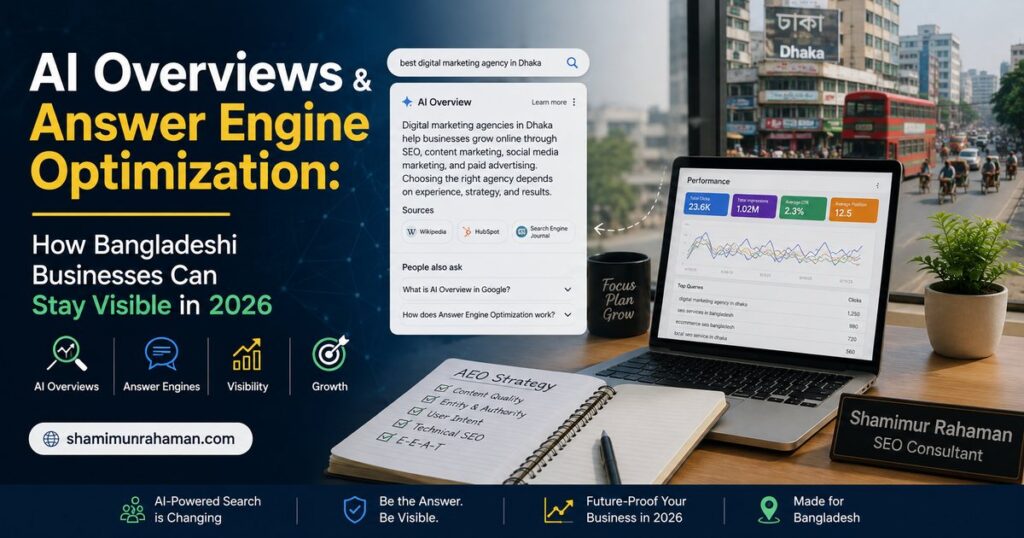
AI Overviews are the AI-generated summary boxes that now appear at the top of many Google search results. Instead of showing ten blue links and letting the user click through to find their answer, Google’s AI reads across multiple sources, synthesizes an answer, and presents it directly on the results page — often with a few source links underneath.
This means a user searching “best SEO consultant in Dhaka” might get a complete answer without ever visiting a single website. For businesses that rely on organic search traffic, this is a fundamental shift in how visibility works.
Alongside AI Overviews, a related concept has emerged: Answer Engine Optimization (AEO), sometimes also called Generative Engine Optimization (GEO). Where traditional SEO optimizes for ranking position, AEO optimizes for being the source an AI system chooses to cite or summarize from.
Why This Matters More in 2026 Than Traditional Rankings
Three shifts are driving this change:
1. Click-through rates on top results are falling. When an AI Overview fully answers a query, fewer users need to click through — even from the #1 organic position. Businesses that only measure success by ranking position are missing half the picture.
2. AI search adoption is growing, especially among younger users. More people — particularly younger, mobile-first users — are turning directly to AI chatbots like ChatGPT instead of typing into a traditional search bar. If your content isn’t structured in a way these tools can easily read and cite, you’re invisible to this growing segment entirely.
3. Search impressions are actually increasing, even as clicks decline. This is a nuance many business owners miss. People are searching more than ever — AI Overviews just mean more of those searches get answered on the results page itself. The businesses that win are the ones whose content gets cited within that AI-generated answer, since a citation still carries brand visibility and trust even without a click.
For Bangladeshi businesses, this shift is arriving at the same time as intense local competition in sectors like e-commerce, real estate, education, and professional services. Businesses that adapt to AEO now will have a real advantage before local competitors catch on — most SEO content in the Bangladeshi market still focuses purely on traditional keyword rankings.
How AI Systems Decide What to Cite
Understanding this changes how you should write. AI systems don’t cite content because it “sounds good” — they cite content that is structurally easy to extract answers from, and that comes from sources the system already trusts. Three factors matter most:
Clarity and structure. AI systems favor content organized around clear questions and direct answers — think concise paragraphs under specific headers, rather than long, meandering prose that buries the answer three paragraphs in.
Trust and authority signals. Just like traditional SEO, AI systems weigh domain authority, author expertise, and consistency of information across the web. A website with clear author bios, credentials, and consistent NAP (name, address, phone) data across the internet is more likely to be treated as a trustworthy source.
Structured data. Schema markup — the behind-the-scenes code that tells search engines exactly what your content means — helps AI systems parse your content accurately. FAQ schema, in particular, maps almost directly onto the question-and-answer format AI systems use to generate responses.
5 Content Changes to Make Today
You don’t need to rebuild your entire website to start adapting. Here are five practical changes that make an immediate difference:
1. Restructure key pages around real questions. Look at your most important pages — services, about, product pages — and ask: what questions is a customer actually trying to answer here? Add clear H2/H3 headers phrased as questions, followed immediately by a direct, concise answer in the first sentence or two. Save nuance and detail for the paragraphs that follow.
2. Add genuine FAQ sections — and fill them with real, distinct answers. This sounds obvious, but it’s one of the most commonly botched elements on business websites. Generic, duplicate, or placeholder FAQ content doesn’t just look unprofessional to visitors — it actively signals low quality to both search engines and AI systems. Every FAQ answer should be specific, accurate, and different from every other answer on the page.
3. Implement FAQ and Organization schema markup. Once your FAQ content is genuinely unique, wrap it in FAQPage schema so search engines and AI systems can parse it programmatically. Add Organization or LocalBusiness schema sitewide so your business’s core facts (name, address, services, contact info) are unambiguous and consistent.
4. Build topical depth, not just page count. AI systems favor sources that demonstrate comprehensive understanding of a topic, not just a single shallow page. If you offer local SEO services, for example, don’t rely on one thin page — build out supporting content that covers Google Business Profile optimization, local citations, review management, and micro-market targeting as their own detailed pieces, all interlinked.
5. Strengthen your brand’s off-site footprint. AI systems (and Google generally) weigh how consistently your business is mentioned and described across the web — your own site, social profiles, business directories, review platforms, and press mentions. A stronger, more consistent off-site presence makes AI systems more confident citing you as a trustworthy source.
A Local Example: What This Looks Like in Practice
Consider two competing local service providers in Dhaka. Provider A has a single generic services page describing their offerings in broad strokes, no FAQ content, and inconsistent contact details across their website and social profiles. Provider B has service pages structured around specific customer questions, genuine FAQ content with schema markup, and consistent business information across their website, Google Business Profile, and social presence.
When a potential customer asks an AI assistant “who offers [service] in Dhaka,” Provider B has a structural advantage on every factor that matters: clarity, trust signals, and structured data. Provider A may still rank reasonably well in traditional search, but is far less likely to be the source an AI system chooses to cite or summarize — meaning they lose visibility in a growing share of searches, even while their traditional rankings stay stable.
This is the quiet risk of ignoring AEO: your traditional rankings can look fine on the surface while your actual visibility to the growing segment of AI-driven search quietly erodes underneath.
Common Mistakes to Avoid
Chasing AI visibility while ignoring the fundamentals. AEO builds on top of solid technical and on-page SEO — it doesn’t replace it. A site with slow load times, poor mobile experience, or crawl errors will struggle in both traditional and AI-driven search.
Writing for algorithms instead of people. Structuring content clearly for AI systems doesn’t mean writing robotic, keyword-stuffed copy. The best-performing content genuinely helps the reader first; the structure just makes that help easier for machines to extract and verify.
Treating this as a one-time project. AI search is still evolving quickly. What works today will need revisiting in six to twelve months as these systems mature. Businesses that build a habit of continually refining their content structure will stay ahead of those who treat this as a single fix.
FAQ
Do I need to abandon traditional SEO for AEO?
No. AEO builds on the same foundation as traditional SEO — technical health, quality content, and authority signals. Think of AEO as an additional layer of optimization on top of solid SEO fundamentals, not a replacement for them.
How long does it take to see results from AEO changes?
Because AI systems continuously crawl and re-evaluate content, well-structured changes can start influencing AI Overview citations within weeks — often faster than traditional ranking improvements, which can take months.
Is AEO only relevant for large businesses?
No — if anything, smaller and local businesses have an advantage, since niche, hyper-specific expertise is exactly what AI systems favor over broad, generic content from larger competitors.
Do I need to use ChatGPT or other AI tools to check my visibility?
It’s a good practice. Periodically search your key questions on Google (checking for AI Overviews), ChatGPT, and Perplexity to see whether your business is being cited, and how competitors compare.
Read more: >AI SEO Guide (2026): The Complete Guide to Ranking on Google, ChatGPT & AI Search
> Top 10 SEO Expert in Bangladesh 2026
Want help auditing your website’s readiness for AI-driven search? Get in touch for a free consultation.
